Available Now

A deeply researched warning about how the digital economy threatens artists’ lives and work—the music, writing, and visual art that sustain our souls and societies—from an award-winning essayist and critic.
There are two stories you hear about earning a living as an artist in the digital age. One comes from Silicon Valley. There’s never been a better time to be an artist, it goes. If you’ve got a laptop, you’ve got a recording studio. If you’ve got an iPhone, you’ve got a movie camera. And if production is cheap, distribution is free: it’s called the Internet. Everyone’s an artist; just tap your creativity and put your stuff out there.
The other comes from artists themselves. Sure, it goes, you can put your stuff out there, but who’s going to pay you for it?
Everyone is not an artist. Making art takes years of dedication, and that requires a means of support. If things don’t change, a lot of art will cease to be sustainable.
So which account is true? Since people are still making a living as artists today, how are they managing to do it? William Deresiewicz, a leading critic of the arts and of contemporary culture, set out to answer those questions. Based on interviews with artists of all kinds, The Death of the Artist argues that we are in the midst of an epochal transformation. If artists were artisans in the Renaissance, bohemians in the nineteenth century, and professionals in the twentieth, a new paradigm is emerging in the digital age, one that is changing our fundamental ideas about the nature of art and the role of the artist in society.

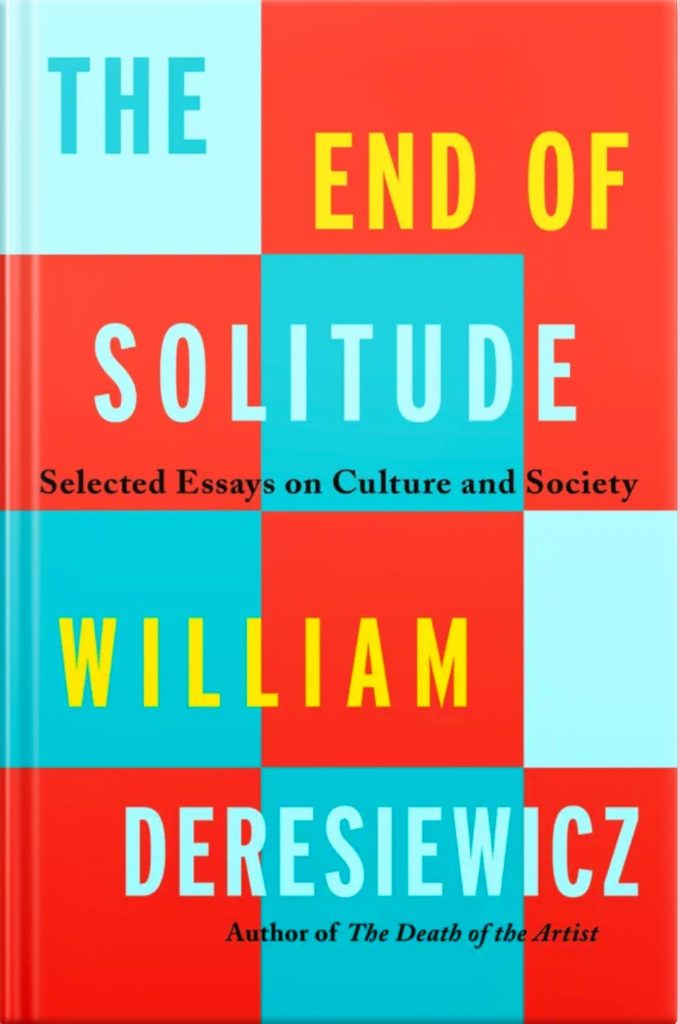
William Deresiewicz [duh-RE-zuh-WITS] is an award-winning essayist and critic, a frequent speaker at colleges, high schools, and other venues, and the best-selling author of Excellent Sheep: The Miseducation of the American Elite and the Way to a Meaningful Life. His new book is The Death of the Artist: How Creators Are Struggling to Survive in the Age of Billionaires and Big Tech.
Bill has published more than 250 essays and reviews. He has won the Hiett Prize in the Humanities, the Balakian Citation for Excellence in Reviewing, and a Sydney Award; he is also a three-time National Magazine Award nominee. His work, which has appeared in The New York Times, The Atlantic, Harper’s Magazine, The American Scholar, and many other publications, has been translated into 17 languages and anthologized in more than 30 college and scholastic readers.
Bill taught English at Yale and Columbia before becoming a full-time writer in 2008. He has spoken at over 130 educational and other venues and has held visiting positions at Bard, Scripps, and Claremont McKenna Colleges as well as at the University of San Diego. His previous book is A Jane Austen Education.
Bill is a member of the Board of Directors of Tivnu: Building Justice, a Jewish social-justice gap year in Portland, Oregon, and of the Advisory Council of Project Wayfinder, which runs purpose-learning programs in schools across the United States and beyond.